- Free Consultation: (936) 766-5171 Tap Here To Call Us




Total THC Lab Errors: Why Your Case Depends on Chemistry


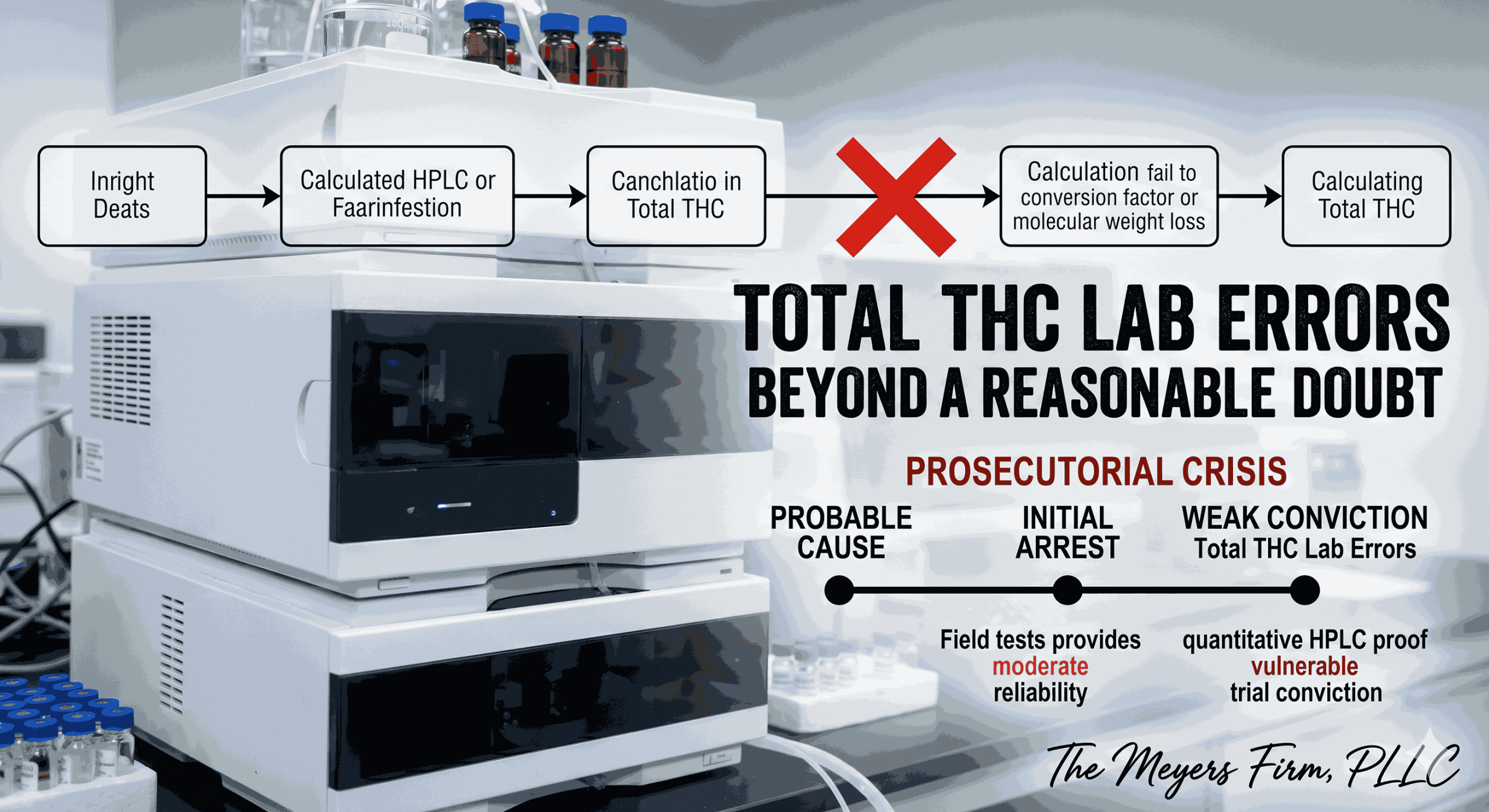
As of May 2026, the Texas judicial system faces a “prosecutorial crisis” centered on a single decimal point. With the state’s shift toward a “Total THC” standard, the difference between a legal hemp product and a felony controlled substance often rests on the precision of a laboratory machine. However, forensic testing is not infallible. Understanding Total THC Lab Errors is now the most critical component of a modern criminal defense.
Under current Texas law, the state must prove “beyond a reasonable doubt” that a substance exceeds the 0.3% THC threshold. To meet this burden, labs have moved away from simple identification to complex quantification using High-Performance Liquid Chromatography (HPLC). Yet, this process introduces multiple opportunities for scientific failure that can lead to wrongful arrests and unconstitutional prosecutions.
The Complexity of the “Total THC” Calculation
The transition to a “Total THC” standard earlier this year fundamentally changed the evidentiary burden in Texas. State regulators now utilize a specific mathematical formula to estimate the maximum potential psychoactive content of a product:
$$\text{Total THC} = (\text{THCA} \times 0.877) + \Delta\text{9-THC}$$
This formula accounts for “decarboxylation”—the process where heat converts non-psychoactive THCA into psychoactive Delta-9 THC. While the math appears simple, the scientific execution is fraught with potential Total THC Lab Errors. If a technician miscalculates the 0.877 conversion factor or fails to account for molecular weight loss correctly, the resulting “Total THC” value is legally void.
Common Sources of HPLC Testing Failures
Most Texas forensic labs utilize HPLC as the “gold standard” for cannabinoid analysis. However, even this high-tech equipment is susceptible to error.
1. Calibration and Dilution Mistakes
HPLC machines require constant calibration using “Certified Reference Materials” (CRM). Because these materials are often highly concentrated, technicians must perform multiple serial dilutions to create a calibration curve.
- The Error: Every manual dilution introduces a margin of error—often averaging 1.14% per step.
- The Result: If a lab performs three or four dilutions, the cumulative error can easily push a legal 0.28% sample over the 0.3% criminal threshold.
2. Mobile Phase Contamination
HPLC relies on a “mobile phase”—a liquid solvent that carries the sample through a pressurized column.
- The Error: Impurities in this solvent, or even minor fluctuations in the lab’s ambient temperature, can cause “noise” or “spikes” on the resulting chromatogram.
- The Result: These spikes can be misinterpreted by software as additional THC, leading to an artificially inflated potency report.https://nvlpubs.nist.gov/nistpubs/ir/2021/NIST.IR.8385.pdf
3. Sampling Bias and Preparation
Texas labs rarely test an entire batch of seized evidence. Instead, they test a tiny “representative” sample.
- The Error: If a technician selects a “hot” bud from the top of a bag or fails to homogenize (blend) the sample properly, the test reflects only that specific fragment rather than the entire lot.
- The Result: A single non-representative sample can trigger a felony charge for a bag of otherwise legal hemp.
The Reliability Gap: Field Tests vs. Lab Proof
A major contributor to Total THC Lab Errors occurs long before the substance reaches a forensic facility. Most roadside arrests in Montgomery and Harris Counties rely on colorimetric field tests./blog/arrested-for-a-thc-vape-pen-in-texas-what-you-need-to-know-now/
These tests are “qualitative,” meaning they only detect the presence of cannabinoids; they cannot quantify them. Because these kits often return a “positive” result for both 0.3% hemp and 0.5% marijuana, they are scientifically insufficient to meet the “beyond a reasonable doubt” standard required for a conviction.
| Step in Prosecution | Required Standard | Reliability of Result |
| Roadside Search | Probable Cause | High: “Smell” justifies the search. |
| Initial Arrest | Probable Cause | Moderate: Field tests justify the arrest. |
| Trial Conviction | Beyond a Reasonable Doubt | Low: Vulnerable to Total THC Lab Errors. |
Why Lab Backlogs Matter for Your Defense
The demand for precise HPLC testing has created a “wholesale foreclosure” on prosecutions in many Texas jurisdictions. Many county labs lack the validated methods or staffing to perform the thousands of required “Total THC” quantifications annually.
If the state cannot produce a certified, error-free lab report within a reasonable timeframe, the evidence remains legally insufficient. In 2026, the “gap” between what an officer claims to smell and what a lab can actually prove is a defendant’s strongest ally.
Conclusion: Holding the State to its Burden
The law does not allow for “approximate” guilt. If a laboratory cannot guarantee the accuracy of its results, the State has not met its burden. At The Meyers Firm, PLLC, we specialize in identifying these Total THC Lab Errors and challenging the scientific foundations of the prosecutor’s case. Paul will hold the State to a standard of precision—because if they cannot prove the percentage, they cannot prove the crime.
Call Paul Now at 936 766 5171 to discuss any THC or criminal law issues you or your loved one are facing.
Get in Touch
Free Consultation (936) 766-5171