- Free Consultation: (936) 766-5171 Tap Here To Call Us



Texas Hemp & Cannabis Law 2026


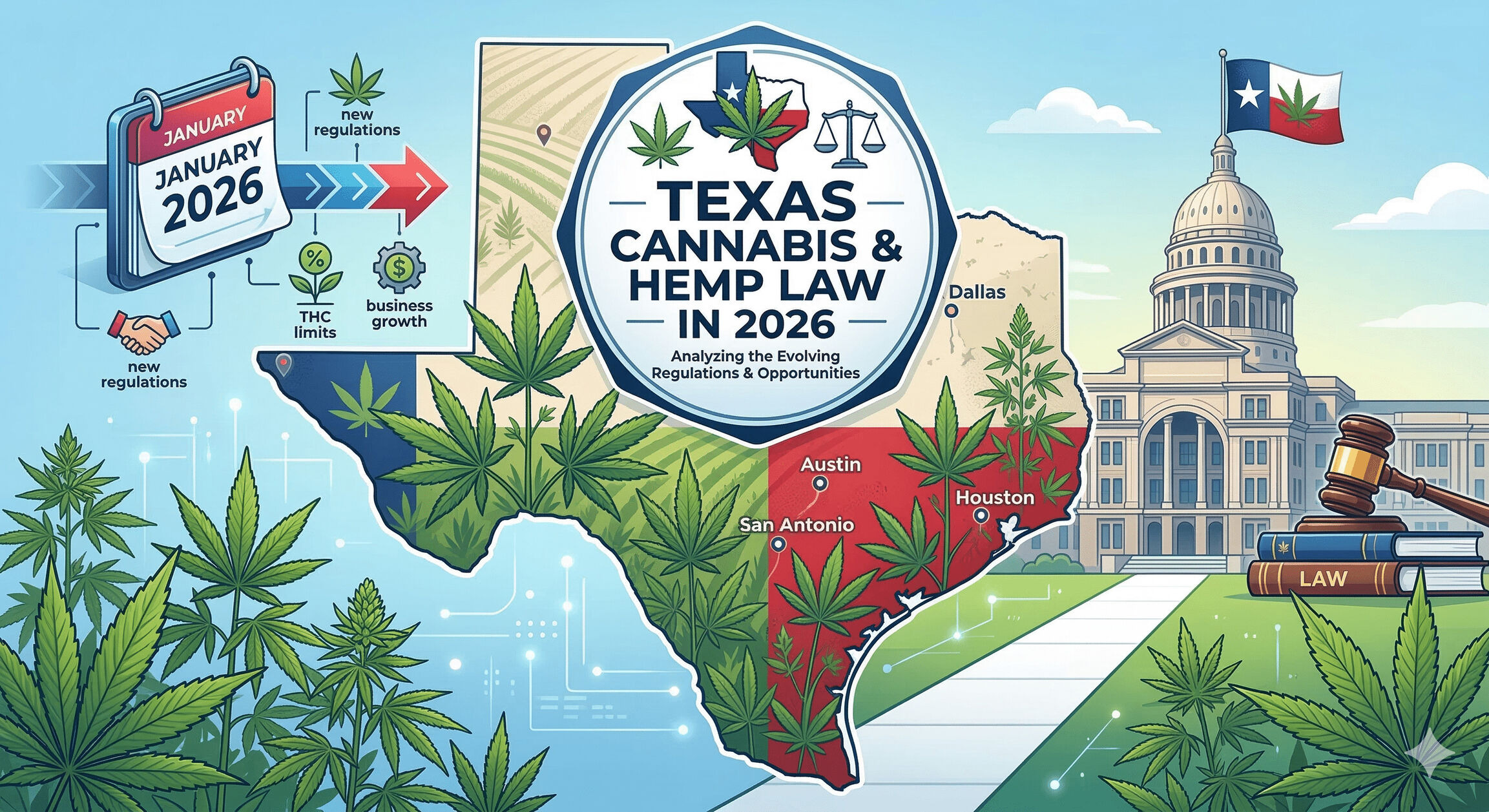
Since the passage of the Texas Hemp Farming Act (HB 1325), the state’s judicial system has struggled with a tug-of-war between police authority and the scientific burden of proof. While recent legislation in late 2025 attempted to close specific loopholes, the requirement for quantitative lab testing continues to result in the dismissal of 15% to 20% of marijuana-related cases across the state. So what is the state of cannabis & hemp law in Texas in 2026?
The “Sight and Smell” Standard: Search vs. Conviction
Understanding the difference in the standard of proof between a roadside search and a courtroom conviction is one of the most critical parts of a legal defense.
Texas courts currently uphold a two-tiered system that often confuses the public:
1. For the Search (Probable Cause)
Texas appellate courts consistently rule that the odor of cannabis provides officers with sufficient probable cause for a warrantless search. Because marijuana remains a prohibited substance, the “plain smell” doctrine allows police to investigate further. This applies even if a driver claims the substance is legal hemp. Consequently, your 4th Amendment protections against searches are lower once an officer claims to “smell weed”.
2. For the Conviction (Burden of Proof)
However, “smell” is not enough once a case reaches the courtroom. To secure a conviction, the State must prove “beyond a reasonable doubt” that the substance is marijuana (over 0.3% THC) and not hemp. Furthermore, an officer cannot determine a THC percentage by sight or smell alone. Therefore, their testimony is legally insufficient to prove a crime occurred.
Insights from the Baylor Law Review: The Forensic Crisis
A Baylor Law Review study titled The State of Marijuana Enforcement After the Texas Hemp Act supports this high dismissal rate. This research identifies a “prosecutorial crisis” caused by a shift from simple identification to complex quantification.https://law.baylor.edu/sites/g/files/ecbvkj1546/files/2023-11/12%20Golden.pdf
The Failure of “Totality of the Circumstances”
The Baylor study argues that hemp and marijuana are botanically identical. Because of this, the old “totality of the circumstances” approach is no longer sufficient to meet the “Beyond a Reasonable Doubt” standard. In the modern courtroom, a scientist with a machine has effectively replaced the officer with a “trained nose”.
The HPLC Bottleneck
To distinguish between 0.3% and 0.4% THC, labs must use High-Performance Liquid Chromatography (HPLC). However, many Texas labs lack the validated methods and staffing to perform these tests for thousands of annual arrests. As a result, this creates a “wholesale foreclosure” on prosecution in jurisdictions that refuse to pay for expensive private lab testing.
2026 Updates: “Total THC” and the Vape Ban
The legal landscape shifted again on September 1, 2025, to address these evidentiary gaps:
- Total THC Standard: Texas law now requires labs to measure Total THC (Delta-9 THC + THCa). This standard specifically targets “THCa flower”. While this broadens what is illegal, it also increases the technical burden on labs to provide precise values.
- The Vape Ban (SB 2024): The marketing and sale of all cannabinoid vapes (including Delta-8 and CBD) is now a Class A misdemeanor. While this targets retailers, it allows police to seize vape devices as “contraband”. Nevertheless, for a possession conviction, the State must still prove the concentration exceeds the legal limit through lab analysis.
Field Tests vs. HPLC Lab Testing: The Scientific Divide
A major point of contention in Texas hemp law 2026 is the reliability of roadside testing. Most officers use colorimetric field tests. While these can detect the presence of cannabinoids, they are notoriously poor at quantifying them. These tests often return a “positive” result for both legal hemp and illegal marijuana. This happens because they cannot distinguish between 0.3% and 0.5% THC.
In contrast, HPLC is the gold standard used in forensic labs. It separates the chemical components of the plant and provides a precise percentage. Because field tests cannot meet the “beyond a reasonable doubt” standard, many cases are stuck in a backlog. Many of these results may never come due to lab staffing shortages and high costs.
Navigating the Legal Landscape
The 2019 Hemp Law and the 2025 updates have made one thing clear: The police have the “green light” to search you, but the District Attorney often has a “red light” at trial. Without a certified lab report proving the 0.3% threshold was crossed, the evidence remains legally insufficient.
| Action | Legal Standard | 2026 Status |
| Roadside Search | Probable Cause | Smell/Sight justifies the search. |
| Arrest | Probable Cause | Field tests will allow initial arrest. |
| Conviction | Beyond a Reasonable Doubt | Requires quantitative “Total THC” lab proof. |
Under the current Texas hemp and cannabis laws in 2026, the State must produce scientific evidence that many counties cannot afford. If you face charges, the “gap” between what an officer smells and what a lab can prove is your strongest ally.
Facing Cannabis Charges in Montgomery County?
If police arrested you for possession of a controlled substance or marijuana, do not assume the case is open-and-shut. As the Texas hemp & cannabis law 2026 standards show, the State faces a massive uphill battle to prove their case in a lab. You need a defense attorney who understands the science of HPLC testing and the current “prosecutorial crisis” in Texas courts. Especially if you are charged with a THC vape case. /blog/arrested-for-a-thc-vape-pen-in-texas-what-you-need-to-know-now/
Paul Meyers at The Meyers Firm, PLLC provides aggressive, knowledgeable defense for those caught in the confusion of Texas cannabis laws. Paul holds the State to its high burden of proof. Paul pushes the State to realize that if they cannot prove the percentage, they cannot prove the crime.
Contact today for a consultation:
- Attorney: Paul Meyers, The Meyers Firm, PLLC
- Phone: 936-766-5171
- Address: 122 W. Davis St. Conroe, TX 77301
Get in Touch
Free Consultation (936) 766-5171