- Free Consultation: (936) 766-5171 Tap Here To Call Us




Constructive Possession and Affirmative Links: How to Fight a Vehicle Arrest in Texas



Imagine sitting in the passenger seat of a friend’s car when a Texas Department of Public Safety officer pulls the vehicle over for a minor traffic violation. The officer conducts a vehicle search and finds a small bag of a controlled substance inside the center console. Because no one claims ownership, the officer cuffs both you and the driver. This multi-passenger scenario routinely results in blanket arrests across Texas. To defeat these charges, you must understand how the state tries to prove guilt when contraband is not found directly on your person. This is called constructive possession and affirmative links.
The Legal Standard: Actual vs. Constructive Possession
Texas law recognizes two types of possession:
- Actual Possession: The item is physically on your person (e.g., in your hand or pocket).
- Constructive Possession: The item is in an area where you do not have immediate physical control, but supposedly exercise care, custody, or management over it.
Under Texas Penal Code Section 1.07(a)(39), possession means “actual care, custody, control, or management.” https://codes.findlaw.com/tx/penal-code/penal-sect-1-07/
Proximity alone does not equal legal guilt. If you face charges due to contraband found near you in a vehicle, the prosecution must establish a strict connection known as Texas constructive possession affirmative links. Knowing how the state attempts to build these cases allows you to coordinate a targeted defense on your [Drug Possession or Weapons Offenses practice area page].
The 14 Affirmative Links Under Texas Law
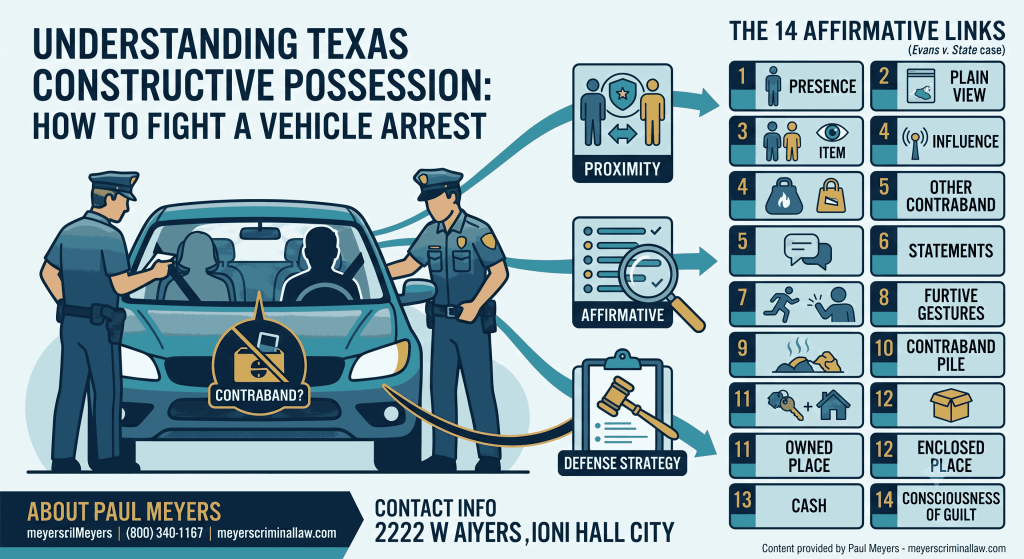
The bedrock principle of Texas case law dictates that mere presence at a scene where contraband is found is legally insufficient to sustain a conviction. In the seminal case, Evans v. State, 202 S.W.3d 158 (Tex. Crim. App. 2006), the Texas Court of Criminal Appeals recognized a non-exclusive list of 14 independent factors that courts use to determine whether an individual knowingly possessed an item. https://law.justia.com/cases/texas/court-of-criminal-appeals/2006/pd-1911-05-5.html
The state does not need to prove all 14 factors, but the cumulative evidence must establish guilt beyond a reasonable doubt:
- The defendant’s presence when the search was conducted.
- Whether the contraband was in plain view.
- The defendant’s physical proximity to and the accessibility of the narcotic.
- Whether the defendant was under the influence of narcotics when arrested.
- Whether the defendant possessed other contraband or narcotics when arrested.
- Whether the defendant made incriminating statements when arrested.
- Whether the defendant attempted to flee.
- Whether the defendant made furtive gestures.
- Whether there was an odor of contraband.
- Whether other contraband or drug paraphernalia were present.
- Whether the defendant owned or had a right to possess the place where the contraband was found.
- Whether the place where the contraband was found was enclosed.
- Whether the defendant was found with a large amount of cash.
- Whether the conduct of the defendant indicated a consciousness of guilt.
Pre-Trial Defense Strategies
An effective criminal defense strategy systematically dismantles these alleged links to force a dismissal before the case ever reaches a jury trial.
Defeating the Charges Before Indictment
A defense attorney can lobby the prosecutor for a dismissal by establishing key facts that break the state’s chain of evidence:
- Proving you do not own the vehicle and were merely a casual passenger.
- Demonstrating the contraband was hidden inside an enclosed space or container belonging exclusively to someone else.
- Highlighting a total lack of incriminating statements, physical impairment, or furtive gestures through a detailed review of police dashcam and bodycam footage.
In Texas, felony charges must pass through a grand jury. Exposing weak Texas constructive possession and affirmative links allows your attorney to present exculpatory evidence and secure a “No Bill,” which dismisses the case completely before indictment.
Trial Defense and Plea Negotiation Leverage
If the District Attorney is able to secure an indictment, systematically exploiting the missing affirmative links serves as your primary leverage during plea negotiations and trial.
When you highlight the gaps in the state’s multi-passenger theory, you force the prosecutor to confront the high probability of an acquittal at trial. If the state refuses to dismiss the case or offer an acceptable reduction, these same missing links form the foundation of your trial strategy. By demonstrating to a jury that the prosecution cannot connect you to the contraband through the required factual factors, your defense attorney can expose reasonable doubt and aggressively pursue a “not guilty” verdict.
CALL PAUL NOW-936 766 5171
Paul Meyers is a criminal defense attorney who defends individuals facing wrongful vehicle arrests. From his office at 122 W. Davis St. Conroe, TX 77301, Paul handles complex possession cases by dismantling weak prosecution evidence. If you were arrested as a passenger during a traffic stop, secure your defense immediately. Visit meyerscriminallaw.com, call 936 766 5171, or email meyerspaulesq@gmail.com to schedule a professional consultation.

Get in Touch
Free Consultation (936) 766-5171