- Free Consultation: (936) 766-5171 Tap Here To Call Us




I-45 Montgomery County Drug Interdiction Arrest


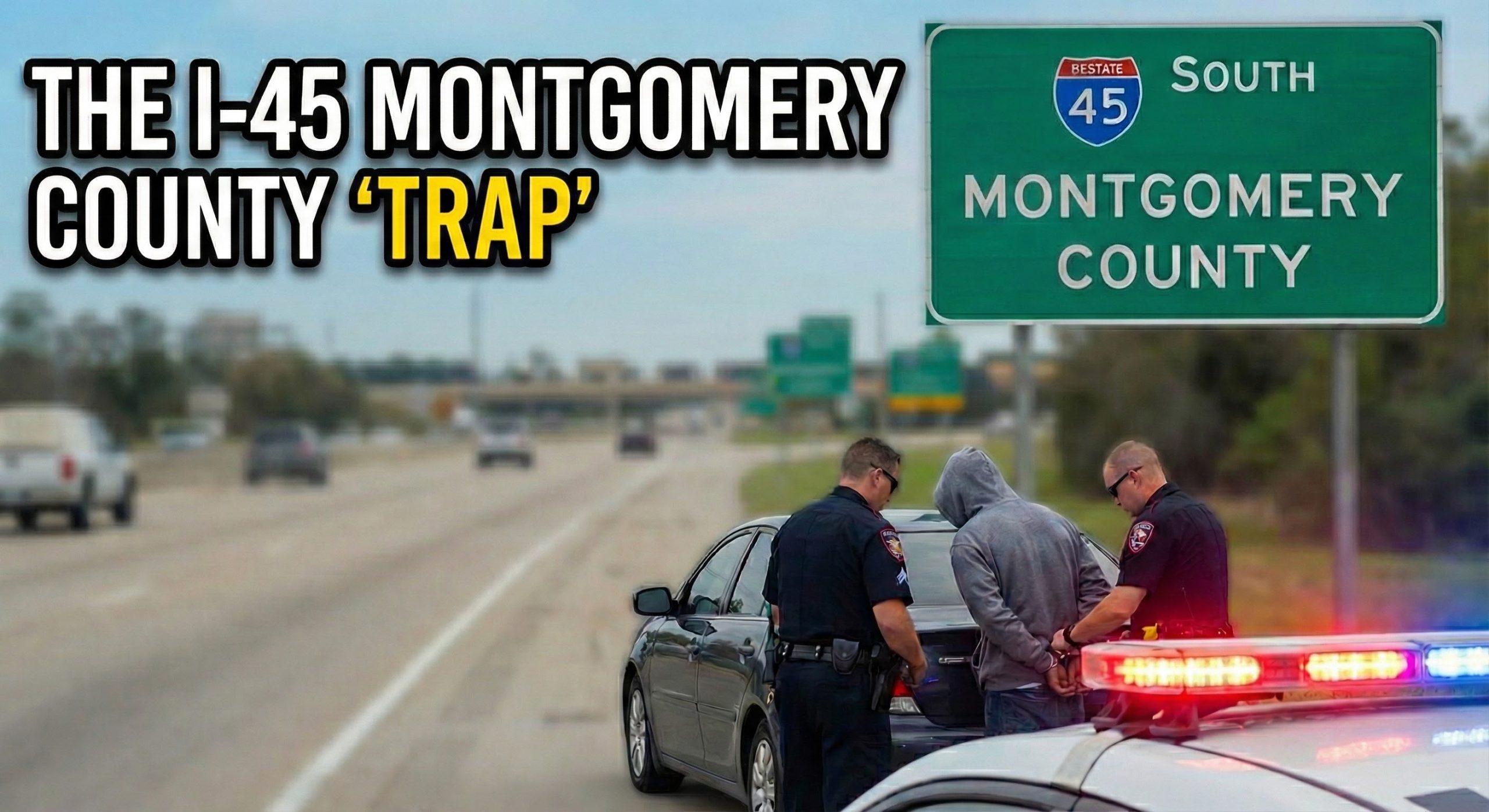
How I-45 Drug Interdiction Pretext Stops Work in Montgomery County, TX and How to Fight Them
If you have ever driven from Spring up to Conroe, you know the heavy police presence on the interstate. This is not an accident; it is a calculated strategy. Law enforcement agencies, including the Montgomery County Narcotics Enforcement Team (MOCONET), treat this corridor as a high-threat zone for narcotics trafficking and I-45 drug interdiction arrests in Montgomery County.
Their primary tool is the “pretext stop”—aka pulling drivers over for minor traffic violations with the ultimate goal being searching the vehicle. Understanding the mechanics of I-45 drug interdiction Montgomery County tactics is critical for anyone facing charges that began with a simple traffic stop. Whether it was for “following too closely” or a license plate frame, these stops are often designed to find drugs, not to enforce traffic safety. /practice-areas/drug-offenses/
I. PRIMARY AGENCIES INVOVLED in Montgomery County Drug Interdiction arrests:
- Montgomery County Narcotics Enforcement Team (MOCONET): A multi-agency task force (Sheriff’s Office, local PDs, Homeland Security) specifically targeting I-45.
- Precinct 3 Constable: Highly active in South County (The Woodlands/Spring area). They utilize dual-purpose K-9 units (e.g., K-9 “Rambo” and “Marlin”) trained for both patrol and narcotics detection.
- Splendora PD: is notoriously active in interdiction on the US-59/I-69 corridor & their tactics often bleed over into joint operations.
II. Common Violations Used:
The following traffic violations are the most common violations used in Montgomery County drug interdiction stops:
- Following Too Closely (Transp. Code § 545.062): Subjective and difficult to disprove without video.
- Failure to Maintain Single Lane (Transp. Code § 545.060): The most common pretext. Officers look for a single tire touch on the fog line or center stripe.
- Obscured License Plate (Transp. Code § 502.409): Often cited for license plate frames that cover any part of the state name or “Texas,” even if the numbers are visible.
- “Criminal Indicators” (Profiling): Officers are trained to look for “nervousness,” “conflicting stories,” “too many air fresheners,” “rental cars with third-party rentals,” or “driving too rigidly” (10-and-2 position).
- The “Wall” Technique: Officers will separate the driver and passenger immediately. They ask the driver about the itinerary (Where are you coming from? Where are you going? How long were you there?) and then ask the passenger the same questions to find inconsistencies. A single discrepancy is used to build “reasonable suspicion” to prolong the detention.
II. LEGAL OPTIONS AND DEFENSES
A. The “Failure to Maintain Single Lane” (FMHSL) Defense
This is the primary weapon to fight the most common traffic violations in a Montgomery county I-45 drug interdiction stop.
- The Rule: A violation of § 545.060 requires two elements: (1) failing to stay within the lane and (2) that the movement was unsafe.
- Key Case: State v. Hardin, 664 S.W.3d 867 (Tex. Crim. App. 2022). https://caselaw.findlaw.com/court/tx-court-of-criminal-appeals/1973689.html
- Law: The Court of Criminal Appeals (CCA) definitively resolved the circuit split (which the 9th COA was previously part of). It held that “incidental weaving” or touching a lane line without creating a safety risk is NOT a violation of the law.
- Practical Use: If the officer’s dashcam shows the vehicle touched the line but there were no other cars around to be endangered, the stop could be challenged as illegal ab initio and may result in the filing of a Motion to Suppress citing Hardin.
B. Prolonged Detention (The “Rodriguez” Clock)
- The Rule: A traffic stop may last only as long as necessary to address the traffic violation (check license, insurance, write ticket). Police cannot extend the stop to conduct a dog sniff unless they develop new reasonable suspicion during that time.
- Key Case: Rodriguez v. United States, 575 U.S. 348 (2015).https://www.oyez.org/cases/2014/13-9972
- Holding: Police may not extend an otherwise-completed traffic stop, absent reasonable suspicion, in order to conduct a dog sniff.
- Key Texas Case: St. George v. State, 237 S.W.3d 720 (Tex. Crim. App. 2007). https://case-law.vlex.com/vid/st-george-v-state-894531966
- Holding: Officers cannot prolong a stop to ask questions unrelated to the traffic violation (e.g., “Do you have drugs?”) once the traffic investigation is reasonably complete, unless they have articulable suspicion.
C. The 9th Court of Appeals (Beaumont)
- Jurisdiction: Covers Montgomery County.
- Trend: The 9th COA has historically been conservative/State-friendly, but they are bound by Hardin.
- Reasonable Suspicion: The 9th COA looks at the “totality of the circumstances.” Mere “nervousness” alone is insufficient to prolong a stop (Wade v. State, 422 S.W.3d 661). A criminal defense lawyer can attack the “stacking” of innocent factors (e.g., driving a rental car + nervousness = reasonable suspicion of drug trafficking).
III. HOW TO FIGHT I-45 Drug Interdiction Arrests in Montgomery County
- Request “Use of Force” Reports on K-9s: If a dog was used, a criminal defense lawyer can request the K-9’s training logs and “false positive” records. In Montgomery County, dogs are often handled by dual-purpose deputies. If the dog “alerted” but no drugs were found, or only residual odor was claimed, attack the reliability of the probable cause.
- The “Hardin” Motion: In every FMHSL case, the video has to be analyzed for a potential motion to suppress challenging the unsafe element. This forces the officer to testify exactly who was endangered by the lane weave.
- Attack the “Consent” Narrative: Officers often use rapid-fire questioning to get “consent” to search. “You don’t mind if I look, right?” If the video shows the client was coerced or the consent was ambiguous, a lawyer could argue the consent was involuntary. Under the Texas Constitution, the State must prove the validity of consent by clear and convincing evidence as well as follow the totality of the circumstances framework outlined under Schneckloth v. Bustamonte. https://statutes.capitol.texas.gov/docs/cn/pdf/cn.1.pdf; https://www.oyez.org/cases/1972/71-732
- Preserve Dashcam/Bodycam Immediately: Montgomery County agencies have retention policies that can be short. A criminal defense attorney can file motions to preserve and/or send a preservation letter immediately upon retention to ensure the “pre-stop” driving behavior (the alleged weave) is not deleted, leaving only the stop itself.
CONCLUSION
Facing charges stemming from a stop on I-45 can feel overwhelming, especially when confronted with the aggressive tactics of local task forces and law enforcement. However, these stops are not bulletproof. At the Meyers Firm, Paul Meyers knows how to challenge the legal basis of the stop under State v. Hardin or attacking prolonged detentions under Rodriguez v. United States.
The “I-45 Trap” relies on drivers not knowing their rights. Paul knows your rights and how to vigorously defend them after an I-45 drug interdiction arrest in Montgomery County, Texas. Contact Paul today to preserve your video evidence and start building your defense. 936-766-5171; meyerspaulesq@gmail.com.
Did the police ask you to get out of your vehicle during an I-45 stop drug interdiction stop in Montgomery County? What are your rights: find out here: /blog/rights-during-a-traffic-stop-in-texas/

Get in Touch
Free Consultation (936) 766-5171