- Free Consultation: (936) 766-5171 Tap Here To Call Us




WHAT THE FLOCK??


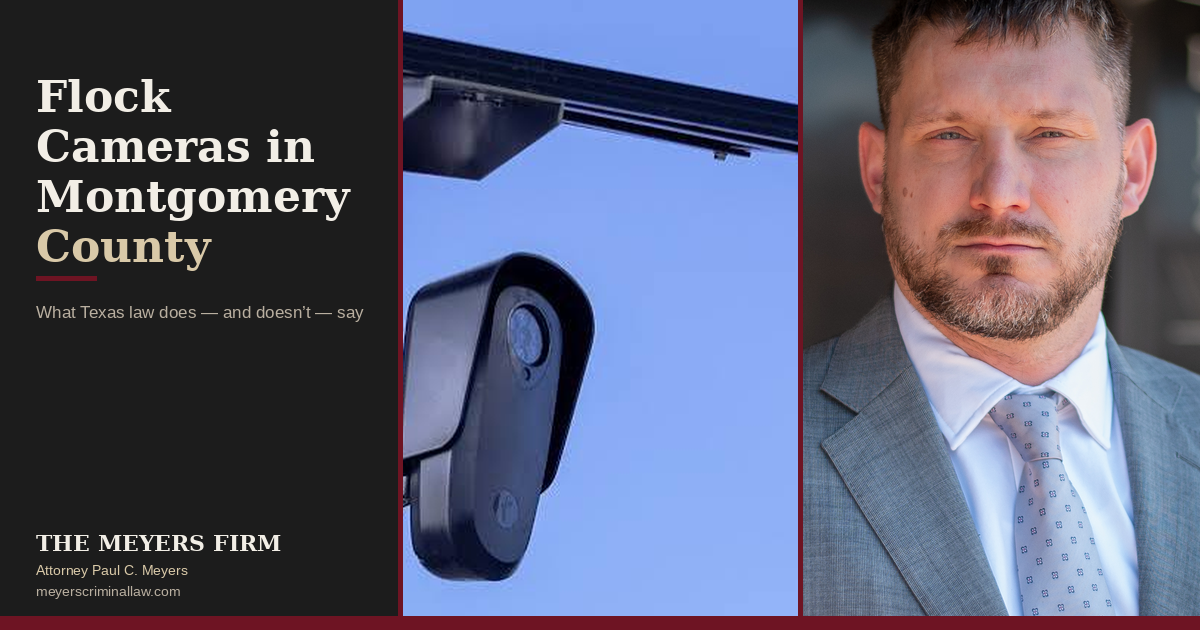
Flock Cameras in Montgomery County & Texas
Flock Safety’s license plate cameras have spread across Montgomery County, Houston, and the rest of the Texas Gulf Coast faster than state law has kept up with them. Here’s what the technology actually does, where it’s watching in this area, and why a U.S. Supreme Court case decided this summer could reshape how prosecutors use the data it collects.
Quick Facts
- Flock cameras in Montgomery County have run since February 2026, according to the company’s own public affairs office.
- The Woodlands Township funded 30 new Flock cameras for the Montgomery County Sheriff’s Office in its FY2026 budget — $109,500 upfront, plus roughly $90,000 a year after that
- The City of Conroe recently rejected a proposal to put the use of FLOCK cameras to a vote https://abc13.com/post/conroe-city-council-rejects-proposal-let-citizens-decide-flock-camera-use/19692089/
- Texas has no statewide law that specifically regulates how police search Flock’s license plate database
- The U.S. Supreme Court decided Chatrie v. United States on June 29, 2026, a ruling could shape how courts evaluate this kind of tracking
What Flock Actually Is
- Flock Safety builds AI-powered cameras that photograph every license plate that passes, not just plates tied to an active investigation
- Each camera logs the plate number, vehicle make, color, and distinguishing features, along with the exact date, time, and location of the scan
- Officers can search that data across Flock’s national network, which now links thousands of camera systems across the country, not just the cameras their own department owns
- Some contracts, including Harris County’s, pair the cameras with gunshot-detection sensors on the same poles
Where Flock Cameras Are Watching in This Area
- Houston has used Flock cameras since 2021, and by 2024, police reported access to around 3,500 of them; individual City Council members funded much of that expansion through their own discretionary accounts
- Harris County signed its first master agreement with Flock in June 2023, and Commissioners Court renewed that contract again on May 28, 2026
- The Montgomery County Sheriff’s Office has run Flock cameras since February 2026, and The Woodlands Township added 30 more this year for its own neighborhoods
- Conroe and League City voters may decide this November whether their cities keep using automated license plate readers at all
Texas Law: What Doesn’t Exist Yet
- No statewide statute currently requires a warrant before police search Flock’s database
- State lawmakers have tried three times to change that — House Bill 3999 in 2023, and House Bills 2083 and 961 in the most recent session — and none of them made it out of committee
- Without statewide rules, each department, HOA, or management district sets its own policy on retention, data sharing, and what justifies a search, and those policies vary widely across the state
- Texas does regulate Flock as a company, though: the Department of Public Safety fined Flock $500 in March 2026 after finding the company operated without the private security license Texas law requires, following a cease-and-desist order for the same problem back in 2024
The Chatrie Question
- On June 29, 2026, the Supreme Court decided Chatrie v. United States, ruling 6-3 that police conduct a Fourth Amendment search when they pull a person’s Google location history through a geofence warrant
- The decision builds directly on Carpenter v. United States (2018), which held that people keep a reasonable expectation of privacy in the whole of their movements, even when a company technically holds the underlying data
- Chatrie is a cell-phone case, not a license-plate case — the Court didn’t rule on Flock or any ALPR system
- Lower courts are already applying its reasoning to Flock litigation anyway: a federal judge in Virginia ruled for the city of Norfolk in January 2026, reasoning that Flock’s cameras don’t capture “the whole” of someone’s movements the way cell-site data does. Privacy advocates now argue Chatrie undercuts that exact reasoning
- Similar Fourth Amendment challenges to Flock’s network are moving through courts in Kansas and California right now, and the Fourth Circuit is taking another look at the Norfolk case
- The open legal question is aggregation: a single camera catching one plate looks like ordinary public observation under United States v. Knotts (1983). A searchable, nationwide network that can reconstruct months of a person’s movements starts to look like the comprehensive tracking Chatrie and Carpenter both protect
What This Means If You’re Facing Flock Evidence in a Texas Case
- Ask early whether Flock data played a role in the stop, the warrant, or the investigation — it often doesn’t show up plainly in the police report
- Request the underlying search log, not just the photo. Flock’s system records who searched the database, when, and what justification they entered
- Watch for searches that reach beyond the department’s own cameras into the national network — that’s where the Chatrie-style aggregation argument gets stronger
- Don’t assume a suppression argument is dead on arrival because Texas courts have upheld ALPR before. Chatrie moved the doctrinal ground under those earlier rulings, and this area is genuinely still shifting
Bottom Line
- Flock cameras in Montgomery County are already logging plates around The Woodlands, and Conroe voters may decide in November whether that continues citywide
- Texas has no law requiring a warrant to search that data, though Flock itself has run afoul of separate state licensing rules
- Chatrie v. United States doesn’t settle the question for license plate cameras, but it gives defense attorneys a stronger doctrinal argument than they had a year ago
Contact The Meyers Firm
If Flock or another ALPR system shows up in your case, the search log matters as much as the photo. The Meyers Firm handles all types of search and seizure issues. /blog/ring-doorbell-evidence-admissible-texas/
Call Paul now at 936-766-5171 or email meyerspaulesq@gmail.com to discuss your case.

Get in Touch
Free Consultation (936) 766-5171