- Free Consultation: (936) 766-5171 Tap Here To Call Us




Federal Firearm Rights Restoration Is Here! One Mistake Can Cost You Five More Years.


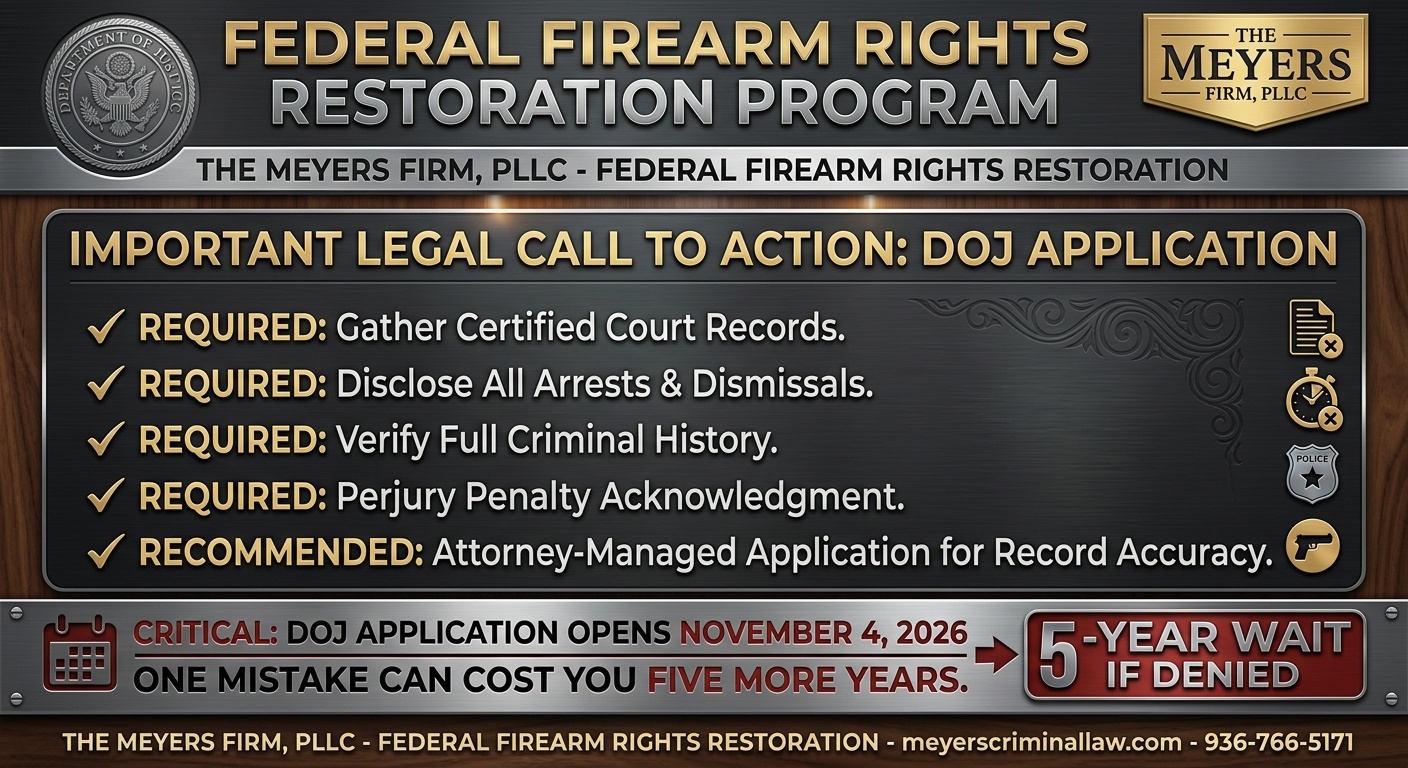
For years, a felony conviction meant a lifetime federal ban on owning a firearm. The only way out was a presidential pardon, and those are rare. That changed in 2026. The U.S. Department of Justice has launched the Federal Firearm Rights Restoration (FFRR) program, and for the first time in decades there is a real, structured path to getting your federal gun rights back.
The program is a genuine opportunity. It also comes with a trap that most applicants will never see coming.
What the FFRR Program Is
Federal law, 18 U.S.C. § 925(c), allows the Attorney General to lift federal firearm disabilities for a person who is not likely to act in a manner dangerous to public safety, where relief would not be contrary to the public interest. After years of the program sitting unfunded, DOJ issued a new rule, and applications are now handled by the Office of the Pardon Attorney through an online process.
The program applies to anyone barred from possessing firearms under federal law. That includes people with state felony convictions, federal felony convictions, and misdemeanor domestic violence convictions, among others./blog/gun-rights-restoration-in-texas/
What a Grant Does, and What It Doesn’t Do in Texas
A grant removes the federal ban. That matters more than most people realize. Many Texans believe that once five years have passed, they can legally keep a gun at home. Under Texas law, that is true. Under federal law, it is not. A person with a felony conviction with a firearm at home can still be charged with a federal felony carrying up to 15 years in prison. FFRR relief closes that gap.
Federal relief does not change Texas law. Texas Penal Code § 46.04 still limits a person with a felony conviction to possessing a firearm only at home, and only after five years. A grant does not authorize carrying a handgun, keeping a gun in your vehicle, or getting a license to carry. Anyone telling you otherwise is not giving you the full picture. However, given this new federal pathway to restoration the climate could be right for States to develop their own methods of handling gun rights prohibitions triggered by federal convictions. In short, this is the biggest development in Federal Gun Rights Restoration in decades.
The Deadlines Are Tight
The public application opens on November 4, 2026, and only the first 5,000 applicants will be accepted, first come, first served. After that, DOJ will open the process in much smaller increments.
Once an application is started, it must be completed within 30 days or it has to be started over. Fingerprints can only be taken after the application is submitted. Three character references must each complete their own sworn forms. State criminal records, certified court documents, and proof that every part of your sentence was completed all have to be gathered in advance. Many of these records take weeks to obtain.
The Five-Year Penalty for Getting It Wrong
This is the part every applicant needs to understand before filing anything.
If your application is denied, you are generally barred from reapplying for five years. Under the DOJ rule, a denial creates a new presumptive disqualifier. A rushed application, an incomplete record, or a missed disclosure does not just fail. It locks you out for five more years.
It gets worse. DOJ also applies its own waiting periods based on the offense: five years for many felonies, ten years for others, and permanent presumptive denial for certain categories. Those clocks do not start until every part of the sentence is complete, including every dollar of fines, fees, and restitution. An applicant who files too early, or who still owes a court balance, can walk straight into a denial and a new five-year wait.
The application is also signed under penalty of perjury. Leaving off an old arrest, even a dismissed or expunged one, can void a grant entirely.
Why Hire a Lawyer
The question is not whether you can fill out the form. It is whether your Federal Firearm Rights Restoration application should be filed, when it should be filed, and whether it will hold up.
An experienced attorney will:
- Review your full history to determine whether you are eligible now, later, or at all, before anything is filed
- Identify waiting periods and disqualifiers that could trigger a denial and a five-year lockout
- Obtain the court, agency, and criminal history records DOJ requires
- Make sure every disclosure matches the records, so the grant is not put at risk
- Present your history, rehabilitation, and circumstances in the strongest possible light
- Manage the deadlines, fingerprinting, references, and communication with DOJ
- Explain exactly what relief will and will not mean under Texas law
One attempt done right is worth far more than a fast attempt that costs you five years.
Talk to The Meyers Firm
At The Meyers Firm, PLLC, attorney Paul C. Meyers secured one of only six Texas Governor’s pardons granted last year. The firm handles pardons, expunctions, orders of nondisclosure, and gun rights restoration, including Federal Firearm Rights Restoration applications, for clients in Montgomery County and throughout Texas. With the November 4 opening approaching, time to prepare is limited.
Call 936-766-5171 or visit meyerscriminallaw.com to schedule a consultation.

Get in Touch
Free Consultation (936) 766-5171